The hot tub file
A hot tub's rim, its inflatable ring, its folded cover — none of them were built to hold a drink, and the accessories sold to fix that keep failing for physical reasons, not bad luck. Here's what's actually happening at the waterline when a can goes over, and what a real fix has to do differently.
The shell rim on a built-in spa is a narrow band of acrylic — contoured and pitched on purpose, so pool water and splash-out run off it instead of pooling on a soaking deck. That's a real plumbing decision, and it works exactly as intended for water. It works the same way on a can.
A thin film of condensation or splash sits between a can's bottom and the acrylic, and friction drops sharply once liquid separates two solid surfaces — a wet film turns a sloped rim into a shallow ramp with almost nothing holding the can back. Add the pump: running jets carry a low, constant vibration up through the shell into the rim, enough on its own to walk a lightweight can toward the edge a fraction of an inch at a time. Neither the slope nor the vibration is dramatic alone. Together, on a surface that's already wet, they're enough.
Lay-Z-Spa and Intex PureSpa owners are working with a different shape of problem. Inflatable tubs have no rigid lip anywhere — the top ring is wide, soft PVC that dips under a leaning arm or a body climbing in, the same way a pool float dips under weight. There's no fixed low point and no fixed high point; the surface reshapes itself with each shift of weight.
The clip-on trays sold for these tubs are an admission of the problem. Intex's own PureSpa tray runs a compact roughly 10.25 by 8.5 inches — small enough to clip onto the ring without it buckling — and its cup wells include drain holes because the maker expects condensation to pool in them. Lay-Z-Spa's own compatibility chart lists eight-plus of its own tub models the tray doesn't fit. An accessory matched to a specific model number, that plans for its own cup wells filling with water, is solving a narrower problem than the one at the rim.
None of this happens in calm water. The Consumer Product Safety Commission's longstanding hot tub guidance caps safe water temperature at 104°F, and safety guides pair that heat with soak windows of roughly fifteen to twenty minutes — which means a soak isn't a single sit-down, it's a session, with people getting in and out, jets cycling on and off, and the surface reacting to both.
A displacement wave rolls once around the shell each time someone climbs in, arriving right where drinks are usually balanced at the waterline. Jet turbulence does something similar on a slower cycle, keeping the surface in a low, constant chop rather than glass-still. A drink set down once at the start of a twenty-minute soak has to survive dozens of small disturbances before that soak is over, not just the moment it was set down.
Pole-mounted swivel side tables aim at the reach problem directly, and owners report the same complaint across brands: the tray leans away from the tub even off a dead-straight pole, because the mount is still fighting the curved, uneven cabinet wall that gives the rim nothing flat to true itself against — and the small drain holes built into the tray let water pool on it instead of running off.
Freestanding side tables and over-the-wall bar caddies run into a fit gamble instead: buyer guides and reviews flag the same issues across brands — a curved shell a flat table edge doesn't match, outdoor weathering and warping over a season, and on larger models, a footprint that eats into the soaking space itself.
Floating drink holders skip the surface problem by not touching a surface at all, which trades one problem for another — jet circulation and displacement waves push them wherever the water moves, and a tall can or tumbler raises their center of gravity enough to tip in the same chop the jets create. None of these are bad ideas; they're solving for a flat, dry, still surface that doesn't exist within reach of a hot tub.
The instinctive fallback is lining drinks up on the deck boards behind your seat, out of the water entirely. A standard hot tub wall runs about 34 to 37 inches, which turns retrieving anything set on the deck into a genuine reach — up, over, and blind if it's an evening soak with the patio lights down and steam rolling off the water. A cooler parked next to the tub solves the supply problem the same way: it keeps drinks cold, but the open can still has nowhere to live once it's cracked, so it goes right back to being balanced on the rim after the first sip.
Reaching for a drink parked on the deck is its own small hazard on both ends — a bare, wet arm lifted out of 100-plus-degree water into open air, often winter air, patted around a dark deck by feel.
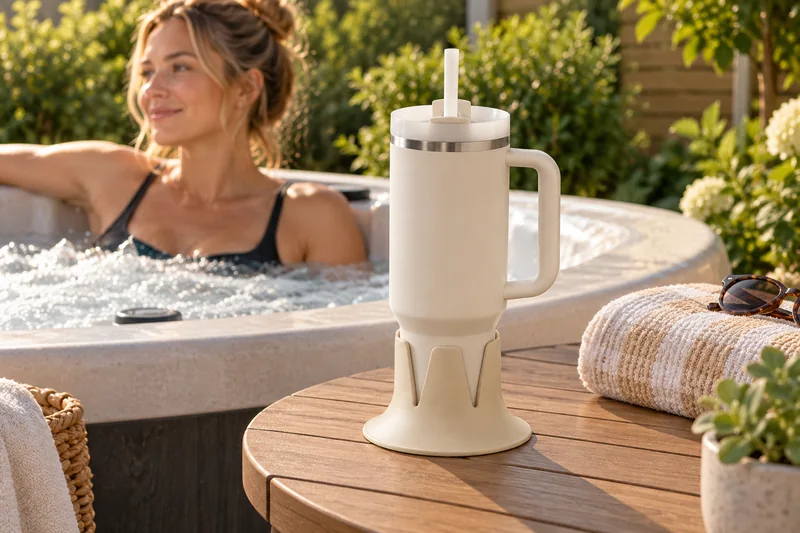
Fixing this without fighting it means giving up on a flat, dry, motionless perch and building around the two surfaces that are actually available: whatever the drink is set on, and the drink itself. A wide, flexible base handles the first part — it drapes over the pitch of an acrylic rim or presses into the dip of an inflatable ring the same way, conforming to the shape that's there instead of needing a shape that isn't. Flexible fins handle the second part, gripping a can or tumbler by its bottom inch directly, so the drink stays held even when the surface underneath it is wet, sloped, or buzzing with pump vibration.
That combination — one solid, injection-molded piece, nothing to fail on its own — is what lets it resist tipping and settle back through a jet cycle or a displacement wave, instead of riding the bump toward the water. Worth being honest about the one place it doesn't pretend otherwise: it isn't buoyant, so dropped straight into the tub it sinks to the bottom like anything else not built to float. Pulled back out and rinsed, it grips exactly the same as before.
That's the physics behind every drink that's gone over the rim, the ring, or the wall — and it's exactly the problem Steadi Labs built this base to solve, one soak at a time.
Get yours at steadilabs.com →You'll finish at steadilabs.com — Steadi Labs is the manufacturer.